
VIÐHALD
Routine Dentistry is the very core of my work. Keeping your horses teeth functional is the key to keeping your horse healthy and happy. Here you will learn about the elements of a routine treatment and what maintenance means in detail. Behind each box there is a link to my Blog where you can dive deeper into Equine Dentistry or other topics!
Is everything healthy?

That is of course the most important priority: are your horses teeth healthy, or is there an infected, broken or otherwise painful tooth bothering him? You can trust in my careful and knowledgeable assessment without missing even the most subtle hint of dental disease - knowing that horses hide pain extremely well makes it even more important to check for problems regularly! Number one rule in horse medicine: You won't know if you didn't take a good look! Just because your horse seems fine on the outside he still might deal with significant pain that he just won't show easily.
Maintaining Incisor Balance

Incisors play a huge role in horses dental symmetry and function. They also have a significant effect on the overall symmetry of your horses body. It is safe to say that most domesticated horses underuse their front teeth. Incisors erupt roughly 2-4mm per year and can grow too long over time, increasing the gap and reducing the contact between cheek teeth, thereby making it harder for your horse to eat. Incisors can develop malocclusions that affect the straightness and subtleness of your riding horse to a huge degree! Trouble bending? Get your horses front teeth checked!
Maintaining Cheek Teeth Balance

Horses cheek teeth have developed to last and function very well for about 10-15 years before they start to slowly deteriorate. .... That goes for wild animals! Most of our domesticated horses underuse their teeth - depending on their feeding regime they will develop so called malocclusions at very early age and repeatedly during the rest of their lives.
My job is to correct and remove malocclusions, bring the horses teeth back to normal function and anatomy and to maintain that balance with regular treatments. If done correctly, a well balanced horse needs a routine treatment every 2-3 years. Functionality and dental health are very closely linked so that it is safe to say that correct maintainance work can prevent dental disease to a great degree!
What about Canines?
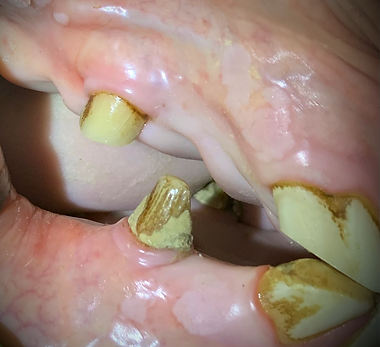
All male horses and some mares have teeth, that sit closely behind the corner incisors. They are the horses "fighting teeth" and are anatomically different from front and cheek teeth - they are quite similar to our teeth actually. Canines get sometimes very long or occasionally chip off, leaving a sharp edge but are generally not of any concern. A tiny bit of tartar on those teeth is not a big and will be removed during treatment - but is the amount of tartar somewhat excessive then that can hint to a problem and the tooth needs careful investigation. It is so easy for you to check your horses front teeth and canines for excessive tartar - just lift the lip and take look!
Wolfteeth - small and
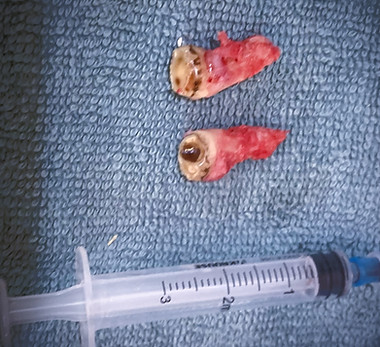
Wolfteeth are rudimentary cheek teeth and appear in almost every horse around the age of 9 months. They are relatively small and sit right in front of the first check teeth right in the bitting area - this makes them so susceptible to being painful when the bit comes in contact with them. That is why we remove them routinely before the horse is introduced to a bit to avoid any bad and painful experiences. Don't mistake the canines for wolfteeth!
Horses change their front teeth as well as the first three cheek teeth from deciduous into permanent dentition. This process begins by age 2,5 and is fully complete by age 5. During this time it is most easy to estimate teh horses age by looking at their teeth. the milk teeth
Bridle fit and Bitfitting

Dies ist ein Textabschnitt. Doppelklicke auf das Textfeld, um den Inhalt individuell anzupassen.